
Residential Property Taxes Likely Headed Up Over Eight Percent - Commercial 4.53 Percent
By Robert Thomas
If you’re wondering how much your residential property taxes are going to rise in 2026 it’s not the 6.95 percent but rather higher.
That’s because the 6.95 percent increase is an average for all taxable properties but each property fits into a class which will pay different percentages once the mill rate factors are factored in.
In the case of residential properties the mill rate factor will see an actual increase of 8.08 percent if approved by Council.
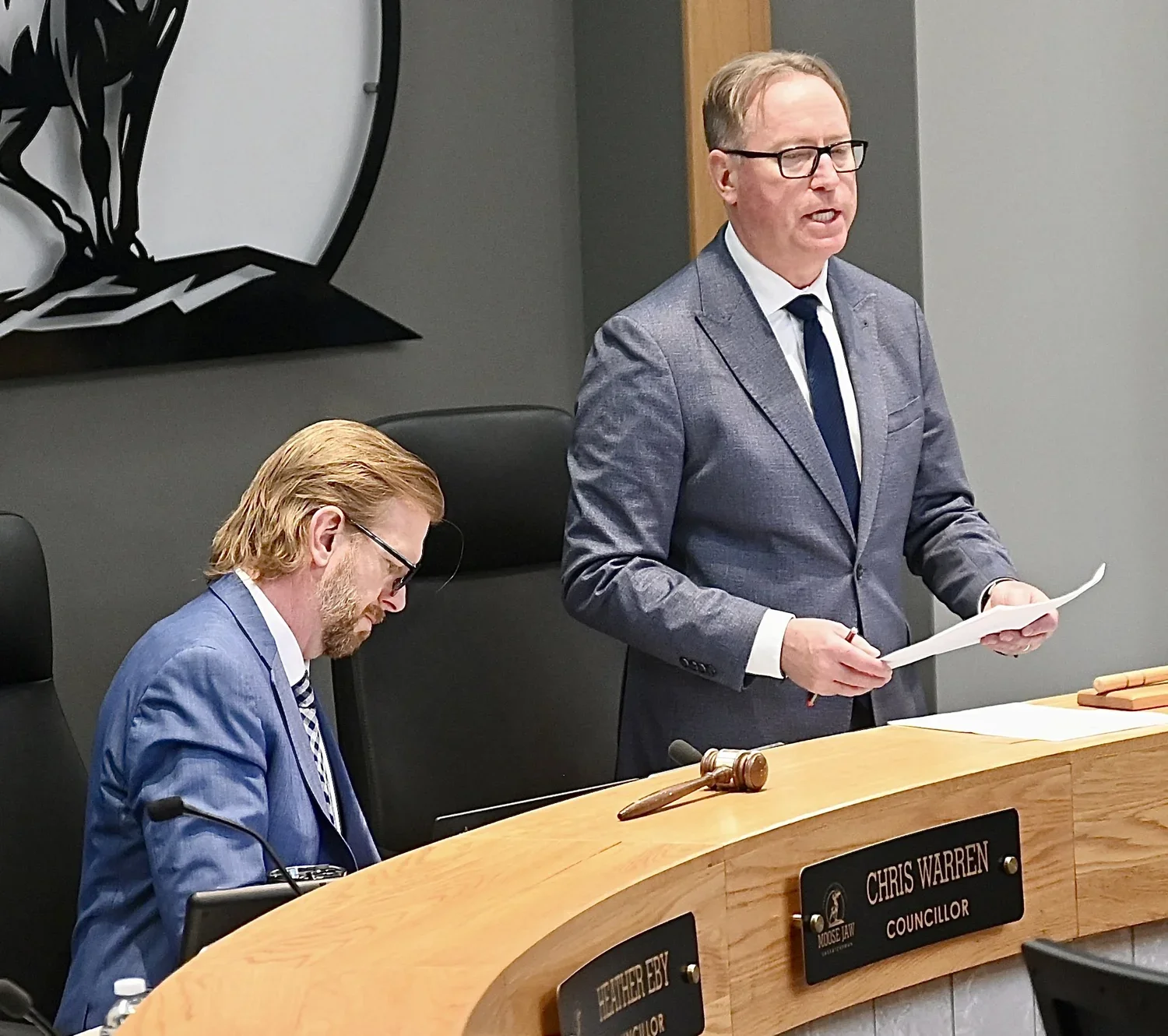
COUNCILLOR CHRIS WARREN (LEFT) AND MAYOR JAMES MURDOCK - MJ INDEPENDENT FILE PHOTO
Mill rate factors are set by tax policy.
The tax policy in Moose Jaw has been to lower the rate difference between commercial and residential properties. It is being doing with a tax sharing approach between the two property classes.
To do this residential properties have higher property tax increases compared to commercial properties over a number of years until equally assessed properties pay the same tax rate.
Commercial Properties
The increase for commercial properties will be 4.53 percent.
The City has traditionally held a commercial appeal allowance - funded by a percentage of all commercial property taxes - to fund successful commercial property appeals.
At the present time there are still 94 commercial property tax appeals before the Saskatchewan Municipal Board(SNB).
In 2025 there was only $12,911 lost to commercial property owners due to assessment errors settled by agreement.
The City also has $30,000 outstanding for bad assessments in prior years in SMB decisions.
At the present time there are potential tax losses of $152,000 the city’s assessor SAMA cannot say whether or not the City or the commercial property owner will be successful in.
The City maintains a reserve of five percent of commercial property taxes to pay for any potential losses and not creating a revenue shortfall.
Councillor Chris Warren asked if there was any way the reserve could be returned to commercial property owners.
Administration said it was possible but jt would be a one year benefit as the mill rate would have to go up in future years to pay for it.
“I do not agree we should keep money for those future potential appeals. I believe we should return the money back to commercial property owners…” Councillor Warren said.
He made a motion to use the $435,850 collected for the commercial property class appeals be used to reduce the industrial mill rate factor for 2026.
Councillor Dawn Luhning said property owners have the right to appeal but “appeals are a risk to a municipality.”
“If we don’t budget for those potential losses in future years we are going to have to collect that money somewhere,” Councillor Luhning said.
“If we lose $800,000 in taxes because the SMB votes in favour of commercial properties where are we going to get the money from? So as much as Councillor Warren thinks it’s a great idea to give the money back to commercial property owners you are causing a risk to taxpayers of this community by doing that,” she said.
Councillor Warren said he understood Councillor Luhning’s concerns and that is why he adjusted the figure from $588,000 in the fund to just $435,000.
Warren said the City had $588,000 in reserves with 94 applications before the SMB that could be a potential loss of $153,000. His motion would maintain a reserve to fund any losses that we get from the 94 appeal currently SMB.
“We’re only collecting what we need when we need it,” he said.
Council was told if the City lost all 94 commercial property taxation appeals at the SMB it would cost $577,277 in tax dollars.
Councillor Boyle said he fundamentally liked Councillor Warren’s idea but he remembered on his first term on Council there was a large retailer who won a massive decision on their property taxes that left the City scrambling for cash when there was insufficient reserves.
“I cannot take the rusk from off there,” he said.
“Councillor Warren if this motion passes puts the City’s tax base at risk,” Councillor Luhning stated. “If you take this five percent away it’s going to hurt more when you’re going to have to find the money later in 2025 when the appeals come through in 2029,” Councillor Luhning said.
Executive Committee voted against returning funds in the commercial property appeal losses to commercial property owners.
The Committee voted in favour of the mill rate factors recommended by Administration.
The final mill rate factors vote is set for the next meeting of Moose Jaw City Council.