
Building Permits Process Explained To About 40
By Robert Thomas
Let’s talk, let’s have a conversation. That was the message brought to contractors, property developers and landowners on Wednesday afternoon.
Speaking to over three dozen people Bob Baker operations manager for Professional Building Inspections (PBI) gave a rundown of the firm’s services and how they affect building standards and permitting by the City.
PBI works as a contractor providing permitting services for commercial buildings for the City earning tens of thousands of dollars. The City has one building permit officer down from three after one resigned. It is a hybrid model - having both public and private sector building inspectors.
For those in attendance hoping for more details as to why the Planning Department is under review there were none forthcoming. There was not a mention of it.
See Related - Planning Department Under Review
https://www.mjindependent.com/new-blog/2026/5/29/k77fabbg6uj1g3sfnckcne5gpqdg8u
The talk was about the building permit process and PBI led the way.
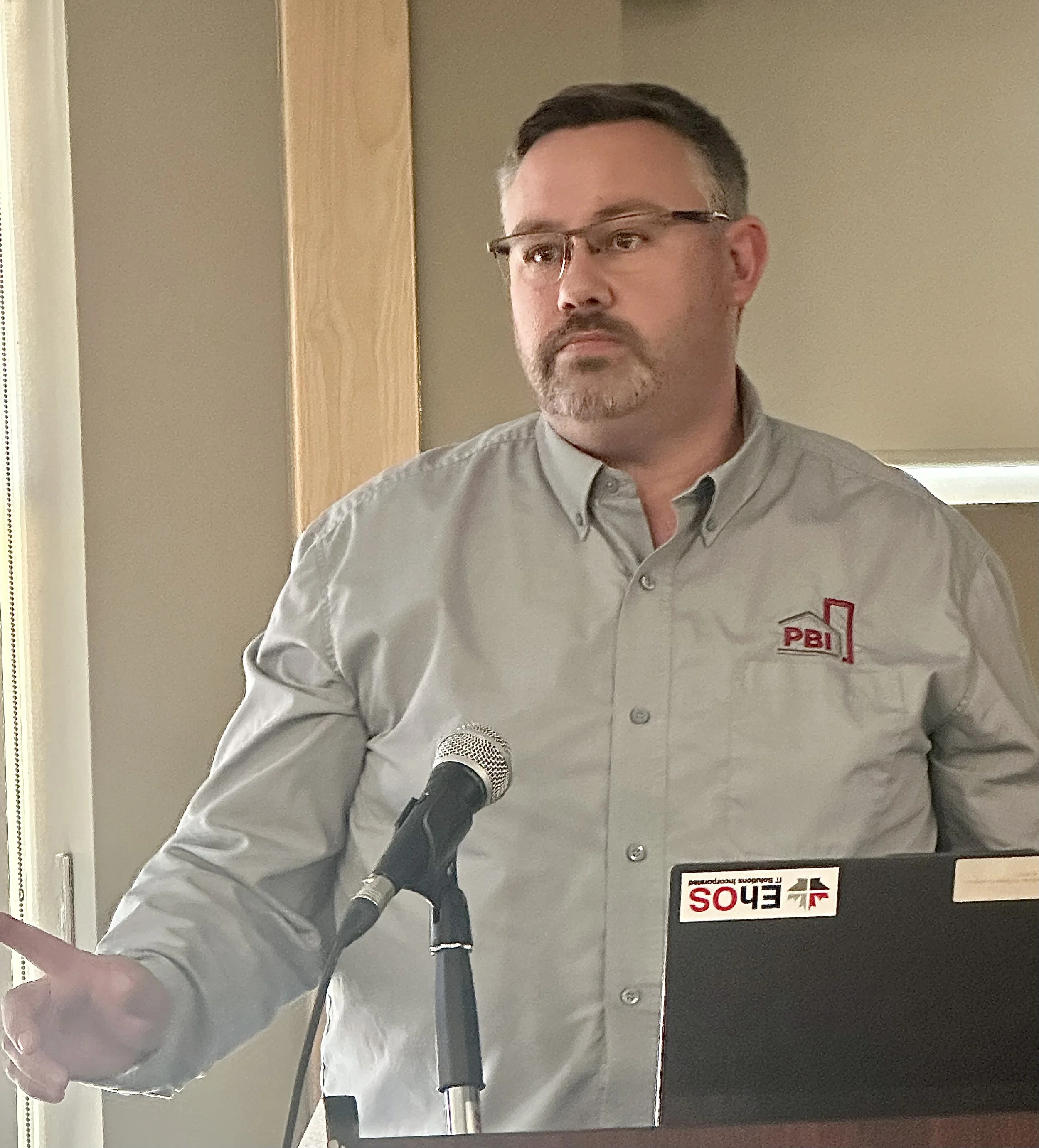
Bob Baker operations manager for Professional Building Inspections - MJ Independent photo
Baker spoke about the responsibility owners have when it comes to complying with the National Building Code (NBC) and other applicable codes.
The NBC is a minimum code or set of safety standards buildings and renovations must be built to for both commercial and residential properties. Permits are issued for new construction and renovations that are compliant with the NBC.
“Ultimately the owner needs to comply (with the NBC),” Baker said.
He said that the onus is on the owner and their designer/engineer to design buildings which are NBC compliant and it’s not up to the building inspector to do this.
“I can’t tell you how to do anything.”
Baker said building inspectors have the ultimate say to approve buildings and have a lot of authority.
“We can enter any building at any reasonable hour to ensure the building is compliant,” Baker said.
There are two main issues when it comes to any proposed development.
Does the development fit into the community (zoning, distances to other buildings and property line) and does it comply with building codes.
The first step in receiving a commercial building permit is a building code analysis.
“For anything other than residential if it doesn’t have a building code analysis we’re not looking at it…it’s going to be much harder to get a permit…spend the money on a building code analysis.”
A building code analysis costs thousands of dollars causing some developers to shy away from them.
Communication between the developer and permit department is key.
“If we are not talking it’s not going to go well.”
He said the permit process is tough with 70 percent of plans not being approved in their first try. But required changes are to follow the NBC which is all about minimum safety standards the owner is ultimately responsible for.
Despite the difficulties he said working together should lead to permits being issued and the project completed.

Peter Wotherspoon chief codes administrator - Ministry of Government Relations - MJ Independent photo
Peter Wotherspoon chief codes administrator for the Ministry of Government Relations spoke about the province’s role when it comes to instituting and enforcing building codes.
The province’s role is a collaborative one.
The department licenses building officials who then work for a municipality.
The department’s main role is to “protect public safety and long term investment.”
The amount of work done every year in Saskatchewan when it comes to building permit values is a massive $2.5 billion, he said.
Ultimately the department’s main role is all about public safety.
“People have the right to be in a safe building no matter who owns it,” Wotherspoon said.
Local authorities are responsible for administering and enforcing construction standards and as such “they need some kind of an expert” to do the job.
Despite the duties of the local authority it still boils down to the owners.
“Ultimately the responsibility is with the owner to get the permits…it all falls back on the owner.”
Wotherspoon said the main reason why a permit is denied is a lack of information.
“Preliminary meetings are really key,” he said.
If a permit is rejected, the applicant isn’t just left stranded trying to figure out why, as they must supply written reasons as to why they did not grant the permit.
Sometimes building inspectors can make mistakes when it comes to issuing permits, and then when it comes to the inspection, the error must be repaired by the owner.
“Everybody is human they are going to miss things along the way.”
Both Wotherspoon and Baker encouraged those in attendance to use their respective websites as free resources as well as providing the opportunity to speak with them afterwards with their questions and concerns.