Widowed by War
By Richard Dowson
My Uncle George Bowbrick, Private, Reg. # B.116692, Calgary Highlanders, was one of the 22,917 Canadian Army soldiers killed in action in World War Two.
He left behind his wife, my Aunt Hazel and two children, a son and a daughter.
My Uncle George joined the army in 1943 and trained to be a truck driver. Life was good. He was posted to a base in Ontario. My aunt took a retail clerk job in Lindsay, Ontario and lived in a small apartment over the store.
Life changed on May 24, 1944 when George was assigned as an infantry reserve soldier to be posted overseas. He was not trained for infantry, but that didn’t matter. The Army would need reserve-replacements for those killed or wounded in the Normandy invasion.
George left Canada for the U.K. June 17, 1944 and arrived in France July 18, 1944, where he joined the Calgary Highlanders.
Five days later, on July 23, 1944, George was wounded by a ‘booby trap’. He was sent to hospital in England. He recovered and was Taken on Strength in Europe, with the Calgary Highlanders, September 21, 1944
George was Killed October 9, 1944.
The tall skinny Geroge Bowbrick, who was 5 foot 9 and weighed 136 pounds, had served 390 days in the Army at the time of his death.
My Aunt Hazel Bowbrick was born in Burks Falls, Ontario. After George was killed, she moved with her two children, Jack and Beverly to Gravenhurst, Ontario to be near his sister and mother. They all lived together, sharing recourses until the end of the war.
Aunt Hazel Bowbrick received a War Service Gratuity of$147.58 from the Canadian Army for George’s 390 days of service. That was it! $147.58. Life was cheap. Widows, like my Aunt Hazel were expected to make a life for themselves, without the help of the Canadian Government.
She got a job in the small Rubberset factory in Gravenhurst making shaving brushes and bristle brushes.
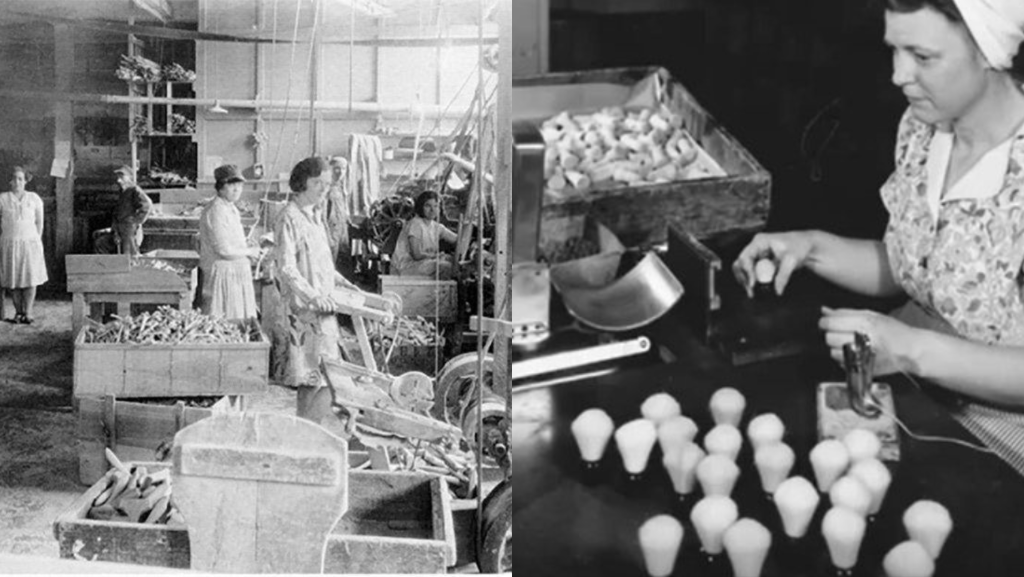
Rubberset Factory, Gravenhurst, Ontario - Credit: The South Muskoka Doppler
Her brother-in-law, Fred helped her build a small, grade-beam, two-bedroom house where she lived and raised her children.
At age 18 Jack joined the PPCLI and fought in Korea. He later re-mustered into the RCAF. Bev grew up and worked in the bank in town.
Aunt Hazel never got over the death of her husband. Life was a struggle. When the Rubberset factory closed, she worked as a cleaning lady at a Gravenhurst motel.
Aunt Hazel’s struggle was not unlike what most war-widows faced.